Muddy Fields vs. Hard Surfaces: How to Choose the Right Bias Tread Pattern for Your Soil and Terrain

For farmers and agricultural operators, selecting the correct bias tire tread pattern is as critical as choosing the right tractor. The wrong tread doesn't just wear faster—it wastes fuel, damages soil, and compromises safety. The challenge is that no single tread pattern excels everywhere. The deep, aggressive lugs that provide maximum traction in muddy rice paddies will vibrate excessively and wear rapidly on hard pavement. Conversely, the shallower, more continuous treads that run smoothly on roads will pack with mud and spin uselessly in wet fields. This article explains how to match bias tire tread patterns to your specific soil conditions and terrain, helping you optimize performance and tire life.
Understanding Bias Tread Classifications
Agricultural bias tires are categorized by tread codes that indicate their intended application. The most common codes for bias construction are R-1, R-2, R-3, and R-4. Understanding these classifications is the first step in making an informed choice.
| Tread Code | Common Name | Lug Depth | Primary Application | Road Performance |
|---|---|---|---|---|
| R-1 | Regular Agricultural | Standard (typically 15-25mm) | General farming, dry to damp soil | Moderate vibration, acceptable wear |
| R-1W | Deep Lug Agricultural | 20-30% deeper than R-1 | Wet fields, moderate mud, heavy tillage | Higher vibration, faster road wear |
| R-2 | Rice & Cane (Extra Deep) | Very deep (30-50mm) | Paddy fields, deep mud, wet rice cultivation | Poor—severe vibration, rapid wear |
| R-3 | Turf | Shallow, smooth | Lawns, golf courses, orchards | Excellent—smooth, low wear |
| R-4 | Industrial | Moderate, blocky | Mixed use, loader work, hard surfaces | Good—stable, moderate wear |
For Muddy Fields and Wet Conditions
R-2: The Ultimate Mud Tire
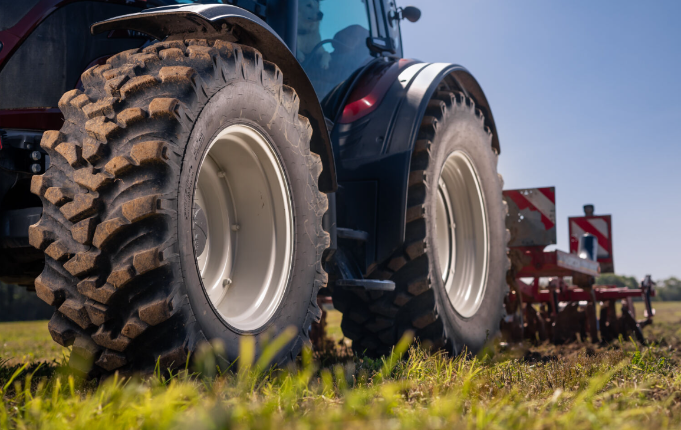
When your primary challenge is standing water, deep mud, or saturated paddy fields, R-2 (Rice & Cane) tread is the specialized solution. These tires feature extremely tall, widely spaced lugs that act as paddles, digging through soft surface layers to grip firmer soil below.
Why R-2 works in mud: The open tread design provides exceptional self-cleaning—mud and debris are thrown clear with each rotation rather than packing between lugs. The tall lugs maximize bite, providing forward traction when lesser treads would simply spin.
The trade-off: R-2 tires are terrible on hard surfaces. At road speeds, the tall lugs create severe vibration that fatigues operators and equipment. Road wear is extremely rapid—hundreds of road miles can destroy an R-2 tire that would last years in field use.
Best for: Dedicated paddy work, wetland farming, operations with minimal road travel. Not suitable for mixed-use farms.
R-1W: The Versatile Wet-Field Option
For farms with significant wet-field work but occasional road travel, R-1W (deep lug agricultural) offers a practical compromise. With lugs 20-30% deeper than standard R-1, R-1W provides excellent mud traction while maintaining acceptable road behavior.
Why R-1W balances needs: The deeper lugs bite into wet soil better than standard R-1, yet the tread spacing is closer than R-2, reducing vibration on hard surfaces. Many farmers find R-1W the optimal choice for regions with moderate rainfall and mixed field conditions.
Best for: General farming in wetter regions, operations with limited road travel between fields.
For Hard Surfaces and Mixed Use
R-4: The Industrial All-Rounder
When your equipment spends significant time on hard surfaces—concrete feedlots, paved roads, gravel lanes, or construction sites—R-4 (industrial) tread is often the superior choice. The shallower, blockier pattern provides stability, reduced vibration, and excellent wear life on abrasive surfaces.
Why R-4 excels on hard ground: The higher rubber-to-void ratio means more tread contact with hard surfaces, improving stability and braking. The blocky design wears evenly and slowly on pavement compared to the rapid, irregular wear of tall agricultural lugs.
The trade-off: R-4 treads pack with mud more easily than open agricultural patterns and provide less bite in deep, wet conditions. They are industrial tires, not optimized for primary field tillage in saturated soils.
Best for: Loader work, feedlot operations, mixed-use farms with substantial hard surface travel, construction and material handling.
R-3: The Turf Protector
For operations where ground disturbance is the primary concern—golf courses, sports fields, fine turf, orchards—R-3 (turf) tread is the correct choice. The shallow, smooth pattern minimizes surface damage while providing adequate traction for mowing, spraying, and light towing.
Why R-3 protects turf: The continuous, low-profile lugs distribute weight evenly without the aggressive digging action of deeper patterns. Soil surface disruption is minimal.
The trade-off: R-3 tires have poor traction in mud or loose soil and are unsuitable for primary tillage or wet-field work.
Best for: Turf management, golf courses, sports fields, orchards with firm ground.
The Standard Choice: R-1 for General Farming
For the majority of mixed-use farming operations—some wet field work, some dry, some road travel—the standard R-1 (regular agricultural) tread remains the most popular and practical choice.
Why R-1 is the baseline: The moderate lug depth provides good traction in most field conditions without the severe road vibration of R-1W or R-2. Wear characteristics are balanced, and the pattern is available from every manufacturer at competitive prices.
Best for: General row crop farming, livestock operations with mixed surfaces, regions with moderate rainfall.
Selection Decision Matrix
Use this decision framework to select your bias tread pattern:
| Primary Operating Condition | Terrain Type | Road Use | Recommended Tread | Rationale |
|---|---|---|---|---|
| Deep mud / standing water | Paddy, wetland | Minimal | R-2 | Maximum mud traction; road use destroys quickly |
| Wet fields, moderate mud | Wet clay, damp soil | Occasional | R-1W | Deep lugs for traction; acceptable road behavior |
| Mixed field conditions | Variable soil moisture | Moderate | R-1 | Balanced performance; most versatile |
| Hard surfaces, loader work | Concrete, gravel, asphalt | Frequent | R-4 | Stability, wear resistance, reduced vibration |
| Turf / fine grass | Lawns, sports fields | Limited | R-3 | Minimizes surface damage |
| Rocky / abrasive soil | Stony fields | Any | R-1 or R-4 | Prioritize cut-resistant compounds over tread depth |
The Critical Mistake: Using One Tread for Everything
The most common and costly error is attempting to use a single tread pattern for all conditions. Farmers who mount R-2 mud tires for wet season work and leave them on for dry season road travel destroy those expensive tires in months. Conversely, farmers who use R-4 industrial tires in deep mud spend hours stuck and spinning.
The solution: Where possible, maintain separate wheel and tire sets for different seasons. Mount R-2 or R-1W for wet field work. Swap to R-1 or R-4 for dry season or road-heavy operations. The investment in second wheels pays for itself in extended tire life and reduced downtime.
Conclusion: Match the Tread to the Terrain
Selecting the right bias tread pattern isn't about finding a single "best" tire—it's about matching the tire to your specific soil, terrain, and usage patterns. R-2 delivers unmatched mud traction but fails on roads. R-4 provides excellent hard-surface stability but struggles in deep wet fields. R-1 offers the balanced performance that serves most mixed-use farms well.
Evaluate your primary conditions honestly. If you work both wet fields and hard roads, consider dedicated tire sets for each. And remember that tread pattern is just one variable—proper inflation, load management, and routine inspection are equally critical to maximizing tire life regardless of which pattern you choose.
From Installation to Storage: 10 Practical Tips to Extend Bias Agricultural Tire Life