In-Depth Analysis of Pressure Units: The Core Role of MPa and PSI in Hydraulic Systems
In-Depth Analysis of Pressure Units: The Core Role of MPa and PSI in Hydraulic Systems
From MPa to PSI: Anchoring the Pressure Measurement Benchmark in Hydraulic Engineering.
1 MPa and PSI: Engineering Origins of the Two Major Pressure Units
MPa (megapascal) is the SI pressure unit, derived from Pascal (Pa): 1 Pa = 1 N/m². 1 MPa = 1,000,000 Pa. As the core of the metric system, it is adopted by China, Europe, and most industrial countries, serving as the primary language of hydraulic system design.
PSI (pounds per square inch) is the imperial pressure unit, representing the pressure exerted by one pound of force uniformly applied over one square inch of area. PSI is widely used for equipment rating in the North American market; almost all U.S.-brand pumps, valves, and hoses use PSI as the nominal pressure standard.
Both essentially represent force per unit area; the only difference lies in the measurement system. Understanding this is a prerequisite for cross-border engineering communication.
2 Precise Conversion and Core Reference Tables
💡 Click any row in the table to quickly fill the corresponding value.
2.1 Standard Conversion Relationships
| Conversion Direction | Exact Value | Common Engineering Value |
|---|---|---|
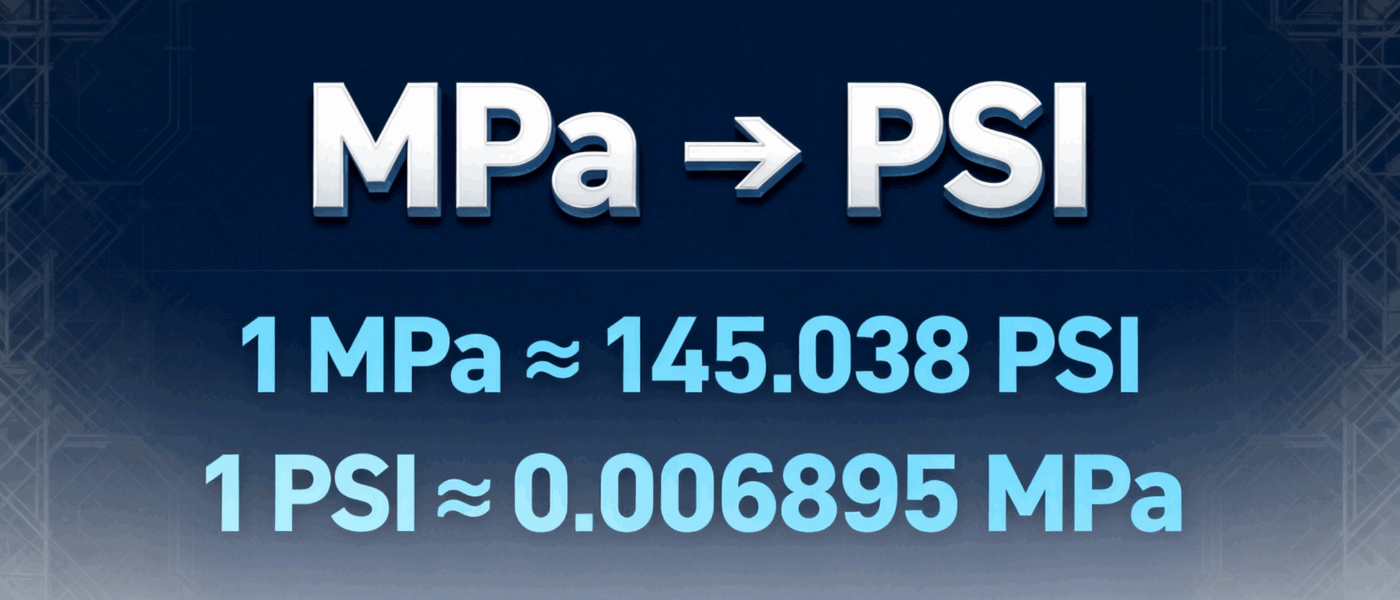
| 1 MPa → PSI | 145.038 | 145 |
| 1 PSI → MPa | 0.00689476 | 0.0069 |
| 1 MPa → bar | 10 | 10 |
| 1 PSI → bar | 0.06895 | 0.069 |
| 1 MPa → kg/cm² | 10.197 | 10.2 |
2.2 Common Pressure Ratings in Hydraulic Systems
| Pressure (MPa) | Corresponding PSI | Typical Application |
|---|---|---|
| 0.1 | 14.5 | Pneumatic control circuits |
| 1.0 | 145 | Low-pressure lubrication and cooling systems |
| 3.5 | 507 | Machine tool fixture hydraulics |
| 7.0 | 1,015 | Standard industrial hydraulic power units |
| 10.0 | 1,450 | General industrial hydraulics |
| 16.0 | 2,320 | Medium-high pressure injection molding machines |
| 21.0 | 3,045 | Construction machinery main circuits |
| 28.0 | 4,060 | High-pressure hydraulic tools |
| 35.0 | 5,075 | Ultra-high pressure hydraulic cylinders |
| 42.0 | 6,090 | Hydraulic demolition tools |
| 60.0 | 8,700 | Extreme high-pressure conditions |
| 70.0 | 10,150 | Waterjet cutting systems |
2.3 Reverse Quick Calculation Tips
To approximate MPa from PSI: PSI ÷ 1000 × 6.9
Example: 3000 PSI ≈ 3 × 6.9 = 20.7 MPa (exact value is 20.68 MPa)
To approximate PSI from MPa: MPa × 145 (use the precise coefficient for engineering calculations)
3 Pressure Interpretation and Common Misunderstandings in Real-World Applications
3.1 Working Pressure vs. Peak Pressure
The pressure on a hydraulic system nameplate may be the rated working pressure, but pressure spikes occur during directional valve shifting and cylinder start/stop. Hose and component rated pressure must cover these spikes, otherwise failure may occur. When converting units, spike values must also be converted.
Misconception 1: "The system pressure is 21 MPa, a hose rated at 3000 PSI is enough."
21 MPa = 3045 PSI. A 3000 PSI hose may have an insufficient safety factor. During selection, the maximum working pressure of the hose must be ≥ the system peak pressure (unified MPa and PSI calculation).
3.2 Importance of Dual-Unit Labeling
In global equipment maintenance, it is common to see only PSI values when replacing American-standard hoses while ignoring MPa conversion. For example, a pump station nameplate pressure of 35 MPa (5075 PSI) using a standard 5000 PSI hose creates an overload risk. The correct approach is dual-unit labeling of hose pressure ratings; procurement and warehouse management must establish a unit conversion review node.
3.3 Instrument Range Selection
The pressure gauge range should be about 1.5 times the maximum system working pressure. When the system is designed in MPa, an MPa-scaled dial should be prioritized to avoid safety risks caused by PSI reading errors.
4 Hydraulic Hose Selection: A Pressure-First Decision Framework
In hydraulic hose selection, pressure capability is the safety bottom line. Below is a streamlined selection process:
Key Action: Including pulses and spikes
Unit Requirement: Convert uniformly to MPa or PSI
Key Action: Max working pressure of hose ≥ system max
Unit Requirement: Check SAE/ISO pressure tables
Key Action: Not less than manufacturer's specified minimum
Unit Requirement: —
Key Action: Inner tube compatibility, temperature in range
Unit Requirement: —
Hose standards: SAE J517 (construction-oriented) and ISO 18752 (performance-oriented), both classify primarily by pressure, using MPa or PSI.
5 Hydraulic Hose Systems: Installation and Troubleshooting Quick Reference
5.1 Mandatory Installation Rules
- Bend plane: Bend in only one plane to avoid twisting. 5% twist can reduce hose life by 70%.
- Straight section: Keep at least 2 times the hose OD of straight section at the fitting.
- Length compensation: Hose can contract up to 4% under pressure; installation must allow for expansion/contraction.
- Fixation: Clamp distribution should be reasonable, avoiding sharp edges and heat sources.
5.2 Common Fault Diagnosis
| Fault Symptom | Key Cause | Countermeasure |
|---|---|---|
| Outer cover cracking | Low-temperature bending, aging | Replace with low-temperature hose |
| Fitting leakage | Improper crimping, vibration | Check crimp, use flange fittings |
| Hose burst | Pressure exceeded (conversion error) | Re-check MPa/PSI, upgrade hose rating |
| Inner tube swelling | Media incompatibility | Check chemical compatibility table |
Hydraulic Hose Flow Rate: The Ultimate Guide to Sizing, Calculation & Selection
UNF vs. JIC Fitting: Understanding the Key Difference for Hydraulic Systems