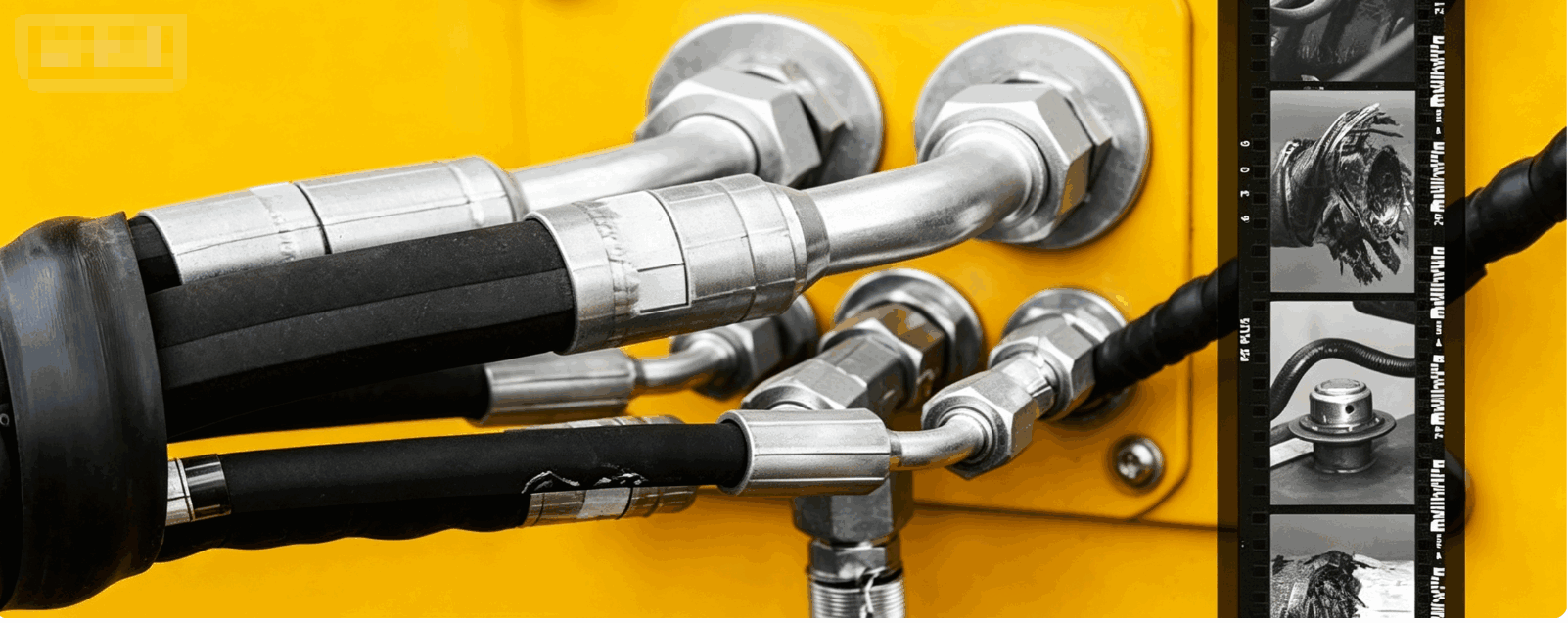
Hydraulic Hose Torsion Prevention: 6 Essential Steps to Eliminate Twisting and Stress

- 1. Why Twisting Destroys Hydraulic Hoses
- 2. Prevention Strategy 1: Zero Twist Installation
- 3. Prevention Strategy 2: Use Swivel Fittings & Adaptors
- 4. Prevention Strategy 3: Respect Minimum Bend Radius
- 5. Prevention Strategy 4: Proper Clamps & Supports
- 6. Prevention Strategy 5: Account for Length Changes
- 7. Prevention Strategy 6: Regular Inspection
- 8. Summary: The 6 Key Prevention Principles
- 9. Conclusion
1. Why Twisting Destroys Hydraulic Hoses
Hydraulic hoses are the lifelines of heavy machinery, transmitting immense power through pressurized fluid. Yet one of the most common—and most preventable—causes of premature hose failure is twisting (torsion) and mechanical stress during installation or operation. The statistics are sobering: twisting a high-pressure hose by just 7 degrees can reduce its service life by as much as 90%. Even 5 degrees of twist per foot can reduce service life by 70%. This guide explains why torsion is so destructive and provides practical strategies to prevent hose twisting and stress in high-pressure hydraulic applications.
Hydraulic hoses are engineered to withstand bending and pressure, but they are not designed to resist torque. When a hose is installed with a twist, the reinforcement layers—steel wire braids or spirals—become misaligned. Under pressure, the hose attempts to straighten itself, which can loosen end fitting nuts or cause reinforcement separation. Excessive torque can even rip the hose from the crimp fitting entirely, causing catastrophic failure.
The failure modes include:
- Diagonal burst patterns: Hoses subjected to torsion fail with a characteristic diagonal opening
- Reinforcement separation: Misaligned wires lose their ability to contain pressure
- Fitting loosening: The natural straightening force of pressurized fluid can back off connection nuts
- Inner liner cracking: Tension and torsion can crack the tube near the coupling
2. Prevention Strategy 1: Proper Installation—Zero Twist Allowed
The golden rule: A hose assembly should never be installed in a twisted condition.
How to ensure zero twist:
- Use the layline as a guide: The printed line running along the hose length should remain straight and parallel to the hose axis after installation
- Avoid "correcting" with a twist: Some technicians intentionally put a slight twist in hoses to avoid obstructions. This practice is incorrect—the hose should be secured with proper routing and clamps instead
- Bend in a single plane: Route hoses so they flex in only one plane of motion. If a compound bend (bending in two directions) is required, divide the path into two segments with a clamp or coupling where the direction changes
- Prevent transient twisting: Even temporary twisting during installation can damage the hose
3. Prevention Strategy 2: Use Swivel Fittings and Adaptors
When hose movement involves rotation or when fittings must be oriented at angles, swivel fittings are essential.
Why swivels work:
- They allow the coupling and hose connection to rotate freely, preventing twisting and kinking
- They compensate for hose length changes when the system pressurizes
- They reduce system rigidity and help absorb hydraulic surges and shocks
- They eliminate the need for bent tubing or complex adapters
Available configurations:
- Inline swivels: Fluid ports on a common axis
- 90° swivels: Allow rotation on a plane perpendicular to the stem axis
- Dual plane swivels: Offer simultaneous pivoting and rotating
- Z-swivels: Move in three planes, ideal for handheld hydraulic tools
When to use adaptors: Use bent tube or block-style couplings and adapters to improve routing and avoid fitting orientation issues. Do not use an angle fitting on both ends of a hose assembly—use a straight fitting on one end and an angle adapter on the other.
4. Prevention Strategy 3: Respect Minimum Bend Radius
Bending a hose tighter than its minimum bend radius (MBR) causes kinking, reinforcement damage, and flow restriction.
Critical rules:
- Never bend the hose in an arc less than the MBR specified by the manufacturer
- Allow at least 1 inch (25 mm) of straight hose out of the fitting socket before it starts to bend
- Do not begin a bend closer than 1.5 times the hose diameter to the ferrule
- Never clamp a hose on a bend—this prevents the hose from expanding and contracting naturally
A minimum free length of 4 times the hose OD plus half the MBR is a good rule of thumb. If the required bend radius falls below the minimum, use an angle adapter to avoid sharp bends.
5. Prevention Strategy 4: Secure with Proper Clamps and Supports
Proper clamping prevents hoses from sagging, rubbing, and experiencing stress from movement.
Clamping best practices:
- The clamp should be 1/32 of an inch smaller than the hose outside diameter for a snug fit
- Do not clamp high and low pressure lines together
- Place a clamp within 6 inches (15 cm) of a fitting to support its weight and prevent stress
- Use clamps of the correct size—a clamp that is too large allows the hose to move inside and causes abrasion
- Never tie down a vibrating hose with wire, rope, or any material that might wear through the cover
For reciprocating motion:
- Rolling loop: Arrange the hose in an unbalanced U-shape with one leg stationary and longer than the second
- Hose reels: Equipped with swivel joints and springs for rewinding
- Hanging loops: Hose hangs in loops from supports, adjusting to changing center-to-center distances
6. Prevention Strategy 5: Account for Hose Length Changes Under Pressure
When pressurized, a flexible hose assembly can change length by as much as +3% or -6% compared to its original length.
What this means:
- Always provide some slack to allow for shortening or elongation
- However, excessive slack creates pressure drops and can lead to S-bends
- Plan for the hose to possibly stretch up to 2% in high-pressure applications
- Do not clamp at bends so that curves can absorb length changes
7. Prevention Strategy 6: Regular Inspection and Proactive Replacement
Even with perfect installation, hoses can develop stress over time.
What to inspect:
- Layline alignment: If the printed line is no longer straight, the hose has twisted
- Cover condition: Look for cracks, abrasion, or signs of kinking
- Fitting condition: Check for pushback, loosening, or signs of stress at the crimp
- Bend points: Inspect areas where the hose bends for flattening or reinforcement exposure
When to replace:
- Follow SAE J1273 guidelines for selection, routing, fabrication, installation, replacement, maintenance, and storage of hose assemblies
- Replace hoses showing any sign of twisting damage, kinking, or reinforcement exposure
8. Summary: The 6 Key Prevention Principles
| Principle | Key Action |
|---|---|
| Zero twist installation | Use layline as guide; never install with torsion |
| Swivel fittings | Use swivels where rotation or angled connections are needed |
| Respect MBR | Never bend tighter than manufacturer's minimum bend radius |
| Proper clamping | Secure hoses with correctly sized clamps; clamp within 6″ of fittings |
| Allow for length change | Provide slack for +3%/-6% pressure-induced length change |
| Regular inspection | Check layline alignment, cover condition, and fittings |
9. Conclusion
Preventing hose twisting and stress in high-pressure hydraulic applications is not difficult, but it requires attention during installation, proper component selection, and disciplined routing. A hose installed with just 7 degrees of twist can lose 90% of its service life—a costly and entirely preventable failure.
By following these six principles—installing with zero twist, using swivel fittings where needed, respecting minimum bend radius, securing with proper clamps, accounting for pressure-induced length changes, and inspecting regularly—you can dramatically extend hydraulic hose life, reduce downtime, and enhance safety. The small investment of time and attention during installation pays dividends in reliability and cost savings over the life of your equipment.
Seeder and Planter Hydraulic Hoses: Types, Applications, and Selection Guide
Mining Dump Truck Hydraulic Hoses: Applications, Selection, and Maintenance Guide