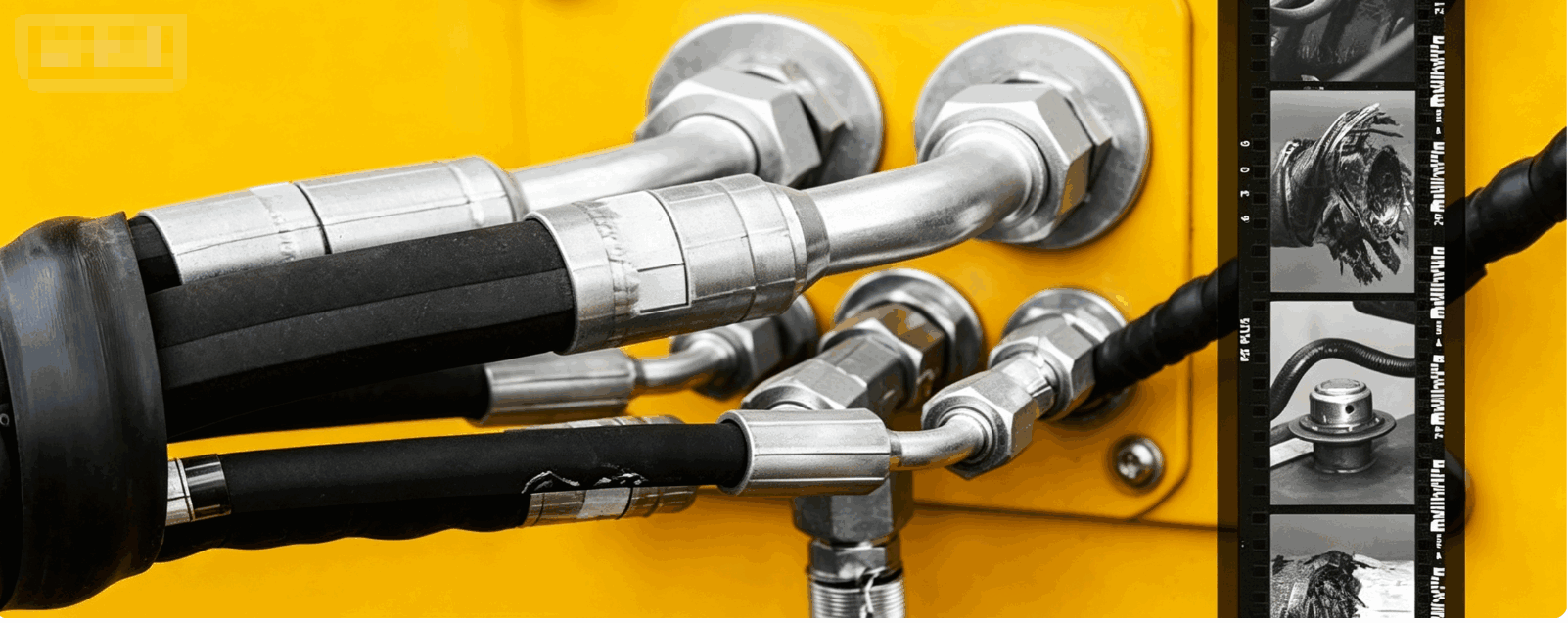
Braided vs. Spiral Hydraulic Hoses for Heavy Equipment: A Comparative Guide

Understanding the Construction Difference
Braided Hydraulic Hose (e.g., SAE 100R1AT, R2AT)
Braided hoses use one or two layers of steel wire braided in a crisscross pattern over the inner tube. The braid is woven like a sleeve, providing excellent flexibility and good pressure containment.
- Single braid (R1AT): One layer of wire braid. Moderate pressure (typically 1,800–3,000 psi).
- Double braid (R2AT): Two layers of braid. Higher pressure (3,000–5,000 psi).
Braided construction offers superior flexibility and a tighter minimum bend radius, making it easier to route in confined spaces.
Spiral Hydraulic Hose (e.g., SAE 100R12, R13, R15)
Spiral hoses use multiple layers of steel wire wound in alternating helical directions (counter-rotating spirals). This construction can have four, six, or even eight spiral layers.
- R12: Four spiral layers. Working pressure 4,000–6,000 psi.
- R13: Multiple spiral layers. Up to 5,000–6,000 psi for larger diameters.
- R15: Six spiral layers. Ultra-high pressure, up to 6,000–10,000 psi.
Spiral hoses are stiffer, have larger bend radii, but excel at handling extreme pressure spikes and impulse fatigue.
| Feature | Braided Hose (R1AT/R2AT) | Spiral Hose (R12/R13/R15) |
|---|---|---|
| Reinforcement | 1 or 2 layers of braided wire | 4-8 layers of counter-rotating spiral wire |
| Working Pressure | Up to 5,000 psi (R2AT) | Up to 6,000-10,000 psi (R15) |
| Flexibility | Excellent (tighter bend radius) | Moderate to poor (larger bend radius) |
| Impulse Fatigue Life | Good | Excellent (designed for high-impulse) |
| Abrasion Resistance | Moderate | Better (thicker cover often used) |
| Typical Applications | General construction, agriculture, medium-duty | Heavy excavators, mining, high-cycle machinery |
| Cost | Lower | Higher |
| Common SAE Standard | SAE 100R1AT, 100R2AT | SAE 100R12, 100R13, 100R15 |
Pressure Rating and Safety Margin
Construction machinery often experiences pressure spikes during sudden stops, bucket impacts, or cylinder stall conditions.
Braided hoses are adequate for many mid-size machines (e.g., backhoes, telehandlers) where working pressure stays below 4,000 psi and spikes are moderate.
Spiral hoses are mandatory for large excavators, wheel loaders, and mining equipment that operate at 5,000+ psi and experience frequent, high-magnitude impulses. Spiral construction better distributes stress across multiple layers, resisting fatigue failure.
Flexibility and Routing
Modern construction machinery has densely packed engine compartments and articulated joints.
Braided hoses are preferred for tight-radius routing, swing circuits, and steering systems where hose must bend around obstacles without kinking.
Spiral hoses are stiff and require generous bend radii. Using a spiral hose in a tight space risks exceeding MBR, causing internal wire damage and early failure. For spiral applications, designers must plan ample routing space.
Impulse Life (Fatigue Resistance)
Impulse life refers to how many pressure cycles a hose withstands before failure.
Braided hoses typically offer good impulse life (e.g., 200,000–400,000 cycles).
Spiral hoses are engineered for extreme impulse duty—often exceeding 1,000,000 cycles. For high-cycle machinery like large excavators that dig continuously, spiral hoses last significantly longer.
Cover and Abrasion Resistance
Construction sites are abrasive environments.
Most braided hoses come with standard synthetic rubber covers.
Spiral hoses, especially those for mining and demolition, often have extra-thick, ultra-abrasion-resistant covers (e.g., R13 with “super abrasion” cover). This is a major advantage on equipment operating in rock, gravel, or demolition debris.
Which One for Which Construction Machine?
| Machine Type | Recommended Hose | Rationale |
|---|---|---|
| Mini excavators (1-5 ton) | Braided (R1AT/R2AT) | Tight spaces, lower pressure, good flexibility |
| Mid excavators (6-20 ton) | Braided for general; spiral for main pumps | Main pump lines benefit from spiral’s impulse life |
| Large excavators (20+ ton) | Spiral (R12/R13/R15) | High pressure, high impulse, severe duty |
| Wheel loaders (general) | Braided (R2AT) for most; spiral for steering/brake | Steering and brake circuits often use spiral for safety |
| Skid steer loaders | Braided (R2AT) | Compact design, moderate pressure |
| Bulldozers (large) | Spiral (R12) for implement circuits | High shock loads from blade impacts |
| Demolition / recycling handlers | Spiral with super-abrasion cover | Extreme debris; maximum protection |
| Cranes (mobile) | Spiral for main lift; braided for pilot lines | Safety-critical circuits use spiral for burst integrity |
Common Mistakes to Avoid
- Using braided hose where spiral is required: In a high-impulse application (e.g., large excavator boom circuit), a braided hose may fail within weeks due to wire fatigue.
- Using spiral hose where braided would work: Installing a stiff spiral hose in a tight bend radius violates MBR, causing internal damage and voiding warranty.
- Ignoring cover requirements: Spiral hose with standard cover will wear through quickly on rocky sites. Always upgrade to abrasion-resistant cover for severe duty.
- Mixing brands and fittings: Both braided and spiral hoses require manufacturer-matched fittings. Do not interchange.
How to Choose: A Decision Flow
- Determine maximum working pressure (including spikes). If >5,000 psi → spiral.
- Evaluate impulse severity. High-frequency cycling (e.g., demolition, continuous excavation) → spiral.
- Assess routing space. Very tight bends (radius < 4x hose OD) → braided.
- Consider abrasion environment. Rock, metal, concrete debris → spiral with super-abrasion cover.
- Check safety criticality. If hose failure could cause injury (e.g., crane hoist), specify spiral for added burst integrity.
Conclusion
For construction machinery, both braided and spiral hydraulic hoses have their place. Braided hoses (R1AT, R2AT) offer flexibility and cost-effectiveness for medium-pressure, tight-space applications. Spiral hoses (R12, R13, R15) deliver unmatched impulse life and pressure capacity for large, high-cycle equipment. The right choice depends on your machine’s pressure profile, cycle frequency, routing constraints, and abrasion risk. Always consult the equipment manufacturer’s specification and hose supplier’s data sheets. Investing in the correct reinforcement type reduces downtime, extends hose life, and enhances job site safety.
Textile Braided Hydraulic Hose: Top Advantages for Low-Pressure Systems
How to Prevent Sharp Bends in Hydraulic Hoses: Causes, Risks, and Solutions