Slurry Circulation Hoses: Suction vs Discharge – Design, Materials, and Selection Guide
Introduction
Slurry circulation systems—whether in mining, dredging, or industrial processing—rely on a carefully engineered network of hoses to move abrasive mixtures of solid particles and liquid. Within these systems, suction hoses and discharge hoses serve fundamentally different roles, each with distinct design requirements. A suction hose operates under negative pressure (vacuum), pulling slurry from a source into the pump. A discharge hose operates under positive pressure, pushing slurry away from the pump to its destination. Using the wrong hose type invites catastrophic failure: a discharge hose used on the suction side will collapse under vacuum; a suction hose used on discharge may burst under pressure. This article provides a professional analysis of the design, performance requirements, and material considerations for both hose types in slurry circulation systems.
1. Suction Hoses: Designed for Vacuum
The suction hose connects the slurry source (e.g., a dredging point, sump, or hopper) to the pump inlet. Its primary challenge is collapse prevention under negative pressure.
Core Design Features
- Steel Wire Helix Reinforcement: A heavy-duty embedded spiral steel wire helix runs the entire length of the hose, providing rigid support against external atmospheric pressure and preventing the hose from being "sucked flat" under high vacuum conditions. Vacuum ratings for slurry suction hoses commonly reach 30 inHg.
- Multiple Fabric Plies: High-tensile synthetic fabric plies (similar to tire cord) are laid over and under the wire helix, providing burst strength and additional structural integrity when the system experiences pressure fluctuations.
- Highly Abrasion-Resistant Inner Tube: The tube (liner) is made from specialized rubber compounds—natural rubber (NR), SBR, or blends—formulated to withstand constant friction, impact, and cutting action from abrasive particles like sand, gravel, and rock.
- Smooth Inner Bore: A smooth interior minimizes friction and prevents material buildup that could lead to clogging.
- Robust End Connections: Flanged ends or specialized couplings ensure leak-proof connections under both vacuum and positive pressure.
Material Comparison: Rubber vs. PVC Suction Hoses
| Material | Rubber (NR/SBR) | PVC with Helix |
|---|---|---|
| Temperature Range | -30°C to +80°C | -5°C to +65°C |
| Abrasion Resistance | Excellent (thick NR tube) | Good (reinforced PVC) |
| Flexibility | Moderate; heavier | Good; lightweight |
| Vacuum Capability | High (helix wire) | High (PVC helix) |
| Best For | Heavy mining, long-term, high abrasion | Light to medium slurry, construction dewatering |
PVC helix suction hoses offer lightweight handling and good chemical resistance for less demanding applications, but rubber suction hoses remain the industry standard for heavy-duty mining and dredging where extreme abrasion resistance is essential.
2. Discharge Hoses: Designed for Pressure
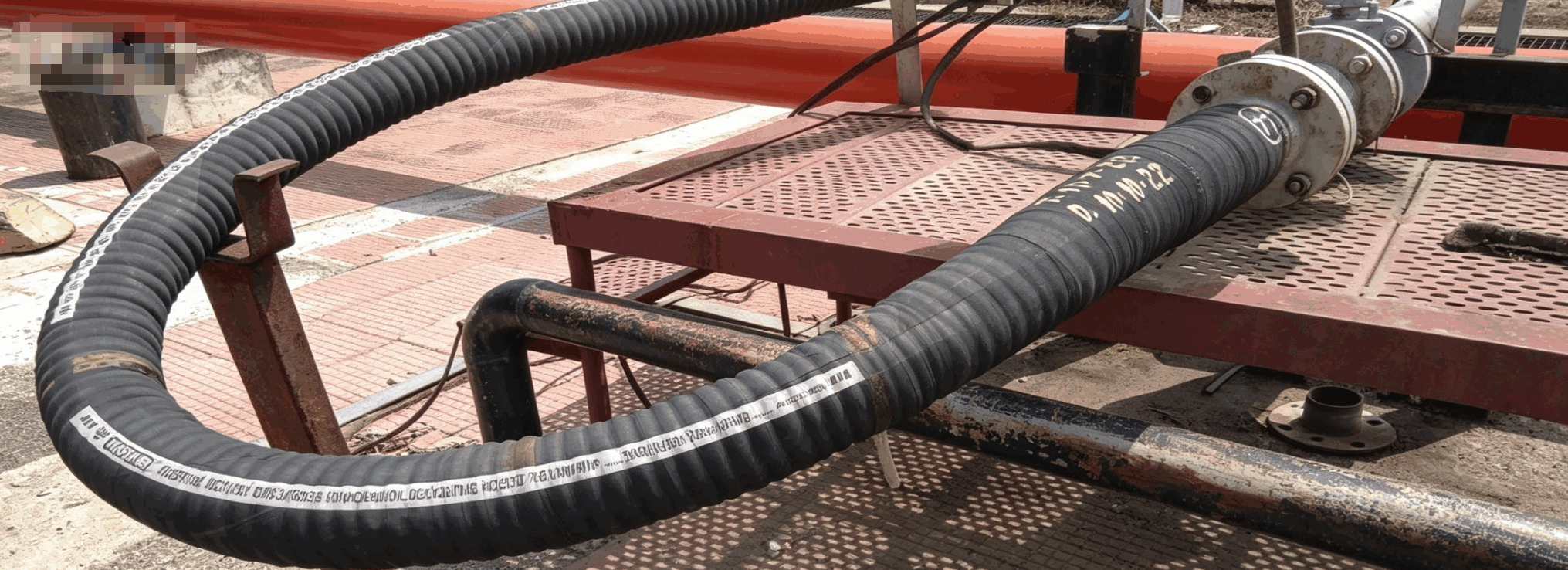
The discharge hose connects the pump outlet to the delivery pipeline. Its primary challenge is withstanding positive pressure while maintaining flexibility and resisting abrasion from the high-velocity slurry.
Core Design Features
- Textile or Wire Reinforcement: Unlike suction hoses, discharge hoses may use a spring wire or textile reinforcement layer rather than a rigid helix. Soft-wall discharge hoses (lay-flat type) lack a rigid wire helix, making them more flexible for transport and deployment, though they generally have a larger minimum bend radius (often 10D).
- Heavy-Duty Inner Tube: The tube must endure both high pressure and continuous abrasion. Kuriyama Alfagomma T719AA, for example, uses a black conductive NR tube with abrasion resistance rated at 50 mm³ and tube thickness of 8mm, reinforced with high-tensile textile cords and an embedded steel wire helix.
- High Working Pressure Ratings: Discharge hoses for slurry applications are typically rated between 150 psi (10 bar) and 22 bar (320 psi). Burst pressure is typically 3-4 times the working pressure.
- Conductive/Static-Dissipative Options: Many slurry discharge hoses feature conductive tube and cover materials to dissipate static electricity, essential for safety in potentially explosive environments.
- Corrugated Cover for Flexibility: Some designs use a corrugated outer cover to increase flexibility while maintaining structural integrity under pressure.
3. Performance Requirements by Slurry Type
Slurry characteristics directly influence hose selection. The table below summarizes recommendations based on application severity:
| Slurry Type | Particle Size | Recommended Hose Type | Key Considerations |
|---|---|---|---|
| Fine Slurry (silt, clay) | <200 mesh | Standard rubber suction/discharge | Critical velocity 13-15 ft/s to prevent settling |
| Sand Slurry | 200-35 mesh | Heavy-duty rubber with abrasion liner | Critical velocity 11-13 ft/s; thicker liner required |
| Coarse Slurry (gravel) | 35-3 mesh | Hard-wall suction hose; ceramic-lined for extreme wear | Critical velocity 9-11 ft/s; reinforced structure |
| Sludge | Variable | Specialized sludge hose | Lower velocity (7-9 ft/s); avoid settling |
(Data source: Critical velocities based on industry standards)
Higher abrasiveness and larger particle sizes demand thicker inner linings, stronger reinforcement, and higher pressure ratings. For highly abrasive coarse aggregate slurry, a different tube material (often with higher durometer rating) is required compared to fine aggregate slurry.
4. Key Performance Comparison
| Parameter | Suction Hose | Discharge Hose |
|---|---|---|
| Pressure Direction | Negative (vacuum) | Positive (pressure) |
| Reinforcement | Rigid steel wire helix + fabric plies | Textile cords + optional spring wire |
| Primary Failure Risk | Collapse (flattening) | Burst (rupture) |
| Typical Working Pressure | Vacuum rating (e.g., 30 inHg) | 150-320 psi (10-22 bar) |
| Min. Bend Radius | 6-8D (hard-wall) | 10D (soft-wall) |
| Burst Safety Factor | 3× minimum | 3-4× working pressure |
| Inner Tube | High-abrasion NR/SBR | Thick NR with abrasion resistance |
| Application | Pump inlet, from source | Pump outlet, to destination |
5. Material Selection: Tube and Cover
The inner tube material must be compatible with both the fluid carrier and the solid particles.
- Natural Rubber (NR): Excellent abrasion resistance, ideal for sand, gravel, and mineral slurries. Kuriyama T719AA uses an NR tube with abrasion resistance of 50 mm³.
- SBR (Styrene-Butadiene Rubber): Good abrasion and aging resistance, often blended with NR.
- NR/SBR Blends: Common for general slurry applications, balancing abrasion resistance and cost.
- Chloroprene (CR) Cover: Provides excellent resistance to abrasion, ozone, seawater, and hydrocarbons. Used as the outer cover on many slurry hoses.
6. Sizing and Flow Velocity Considerations
Proper hose diameter is critical for both suction and discharge performance.
Too small: High velocity increases wear on the inner lining, creates excessive friction, and raises energy consumption.
Too large: Low velocity leads to sedimentation, particle settling, and potential clogging.
Target slurry velocity is typically 3-5 m/s (approximately 10-16 ft/s), depending on the material being pumped. For mining slurries, recommended velocities range from 9-15 ft/s based on particle size classification.
7. Matching Hose to Pump and System
Hose selection must be integrated with pump parameters. Key steps:
- Define pump parameters: Flow rate (m³/h), discharge pressure (bar), suction pressure/vacuum level, pump type.
- Match diameter to flow rate: Calculate appropriate ID to achieve target velocity.
- Align pressure ratings: Ensure working pressure ≥ pump discharge pressure; burst pressure ≥ 3× working pressure. Account for pressure spikes during startup or blockages.
- Consider slurry characteristics: Particle size, solid concentration (%), and abrasiveness determine required inner lining thickness and reinforcement strength.
- Account for pipeline layout: Total length, elevation changes, number of bends, and booster pump positions all affect hose requirements.
8. Conclusion
Suction and discharge hoses for slurry circulation systems are engineered for opposing pressure environments. Suction hoses require rigid steel wire helix reinforcement to prevent vacuum collapse, while discharge hoses prioritize pressure containment with textile cord reinforcement. Both demand highly abrasion-resistant inner tubes, proper sizing for optimal flow velocity, and compatibility with the specific slurry being conveyed. Using the correct hose type for each position—suction on the inlet, discharge on the outlet—is not optional; it is essential for system reliability, safety, and longevity. Proper matching of hoses to pumps, slurry characteristics, and pipeline layouts extends service life, reduces downtime, and lowers total cost of ownership in demanding mining and dredging operations.
Offshore Hydraulic Hose Selection: Corrosion Resistance for Lifting and Handling Equipment
EPDM vs NBR Hose: A Complete Guide to Rubber Material Selection for Fluids