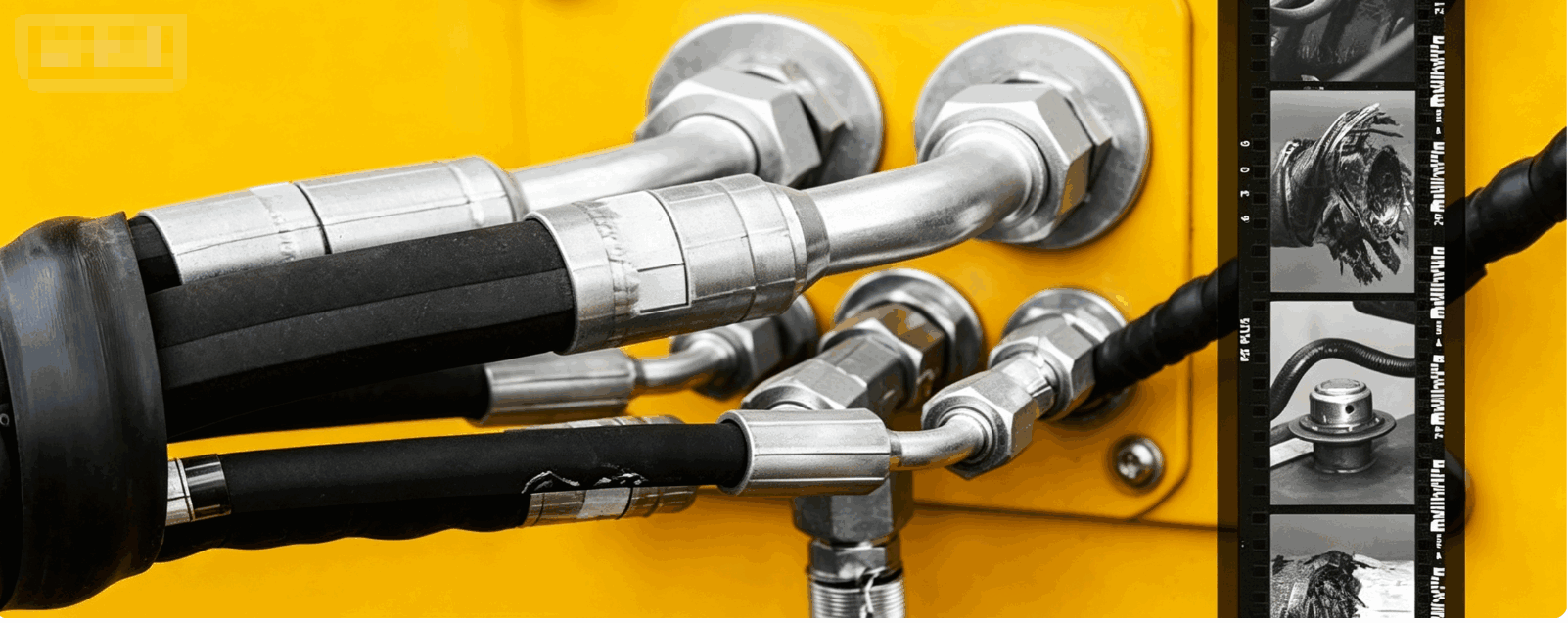
Agricultural UV-Resistant Hydraulic Hoses: Protecting Outdoor Farm Equipment from Sun Damage

- 1. Why UV Degradation Destroys Hydraulic Hoses
- 2. What Makes a Hydraulic Hose UV-Resistant?
- 3. Recommended UV-Resistant Hydraulic Hose Types
- 4. How to Identify a UV-Resistant Hose
- 5. Best Practices for UV Protection on Farm Equipment
- 6. Common Outdoor Farm Equipment and Recommended Hoses
- 7. Limitations: What UV-Resistant Hoses Cannot Do
- 8. Conclusion
Why UV Degradation Destroys Hydraulic Hoses
Farm equipment lives outdoors. Tractors, combines, sprayers, balers, and forage harvesters spend their working lives under direct sunlight, exposed to UV radiation day after day. Standard hydraulic hoses—even those rated for high pressure—can degrade rapidly when subjected to prolonged UV exposure. The outer cover cracks, the reinforcement becomes exposed, and the hose fails prematurely. This guide explains why UV resistance matters for agricultural hydraulics, how to identify UV-resistant hoses, and which types are best suited for outdoor farm equipment.
Ultraviolet (UV) radiation from sunlight breaks down the polymer chains in rubber and many thermoplastics. The result is a process called weathering or UV degradation, characterized by:
- Surface cracking (checking): Fine cracks appear on the hose cover, often in a spiderweb pattern.
- Chalking: The black cover turns gray or white as the surface rubber oxidizes.
- Loss of flexibility: The cover becomes hard and brittle.
- Deep cracking: Cracks propagate to the reinforcement layer, allowing moisture and contaminants to reach the steel wires.
- Corrosion: Once water reaches the steel braid or spiral, rust accelerates and burst pressure plummets.
For outdoor farm equipment, UV damage is not a matter of "if" but "when." A standard hose without UV protection may fail in 1-2 years of full sun exposure. A UV-resistant hose can last 5-10 years.
What Makes a Hydraulic Hose UV-Resistant?
UV resistance comes from the outer cover compound and any additional protective layers. Key factors include:
- Cover Material: Certain elastomers resist UV better than others.
Excellent: EPDM (ethylene propylene diene monomer), chloroprene (neoprene), polyurethane
Good: CPE (chlorinated polyethylene), CSM (Hypalon®)
Poor: Natural rubber, standard nitrile (NBR) without additives - UV Stabilizers and Antioxidants: Manufacturers add carbon black (which absorbs UV), hindered amine light stabilizers (HALS), and waxes to the rubber compound. High-quality hoses contain significant carbon black loading (typically 30-40 phr).
- Cover Thickness: Thicker covers (2-3 mm vs. 1-1.5 mm) provide more UV barrier before cracks reach reinforcement.
- Textile or Polyurethane Outer Braid: Some hoses add a textile or polyurethane layer over the rubber cover for extra UV and abrasion protection.
Recommended UV-Resistant Hydraulic Hose Types for Outdoor Farm Equipment
| Hose Type | UV Resistance | Cover Material | Best For |
|---|---|---|---|
| SAE 100R5 | Good to Excellent | Textile braid over rubber; often EPDM or neoprene | General farm hydraulics, loader lines, steering |
| SAE 100R2AT with EPDM cover | Excellent | EPDM rubber | High-pressure circuits, balers, combines |
| SAE 100R12 / R13 / R15 (spiral) | Good to Excellent | Neoprene or EPDM covers | Heavy tillage, large tractors, high-impulse |
| SAE 100R7 / R8 (thermoplastic) | Variable | Polyurethane (best) or polyester (poorer) | Boom folding, sprayer controls (check spec) |
| Textile-braided (R6) with UV cover | Moderate | Thin rubber; less durable | Low-pressure return lines, not exposed |
| Polyurethane-covered hoses | Excellent | TPU (thermoplastic polyurethane) | Extreme UV and abrasion, mining, demolition |
Key recommendation: For exposed outdoor farm equipment, specify hoses with EPDM or neoprene covers. Avoid hoses with only standard nitrile (NBR) covers unless they are specifically labeled "UV-stabilized."
How to Identify a UV-Resistant Hose
Look at the hose layline (printed text) and the cover surface:
- Layline markings: May include "UV resistant," "weather resistant," "ozone resistant," or cover material (e.g., "EPDM cover").
- Cover appearance: A high-quality UV-resistant cover has a matte or semi-gloss black finish. Cheap covers often look shiny and feel slippery.
- Bend test: If a small sample cracks when bent sharply after a few months outdoors, it lacks UV protection.
If the hose has no markings about cover material, assume it is standard nitrile (NBR) with limited UV life.
Best Practices for UV Protection on Farm Equipment
Even with UV-resistant hoses, additional measures extend service life:
- Use nylon or polyurethane spiral wrap on hoses that are chronically exposed (e.g., on loader arms, sprayer booms). This adds a replaceable UV barrier.
- Apply UV-blocking sleeve (e.g., Velcro wrap or woven polyester) on hoses near cab roofs or other high-sun areas.
- Store equipment indoors or under cover when not in use for extended periods (winter storage). This dramatically reduces UV exposure.
- Inspect hoses annually before planting season. Look for cracking, chalking, or hardness.
- Replace hoses showing any surface cracks that reach reinforcement. Do not wait for failure.
Common Outdoor Farm Equipment and Recommended Hoses
| Equipment | Exposed Hoses | Recommended Hose | Cover Requirement |
|---|---|---|---|
| Tractor (front loader) | Lift and curl hoses | SAE 100R2AT or R16 | EPDM or neoprene; add spiral wrap |
| Self-propelled sprayer | Boom fold, lift, suspension | SAE 100R7 (thermoplastic) or R5 | Polyurethane or EPDM cover |
| Round baler | Gate, tailgate, pickup | SAE 100R2AT or R12 | EPDM cover; often chafes, so sleeve |
| Combine (harvest head) | Reel, auger, header lift | SAE 100R5 or R2AT | Textile cover (R5) or EPDM |
| Forage harvester | Spout rotation, chopper | SAE 100R12 | Neoprene or EPDM, heavy-duty |
| ATV/UTV sprayer | Boom and pump lines | SAE 100R6 or R7 | Add UV sleeve if rubber-only |
Limitations: What UV-Resistant Hoses Cannot Do
Even the best UV-resistant hose will eventually degrade. Expect 5-10 years of outdoor life, not decades. Also, UV resistance does not protect against:
- Ozone cracking (different chemical attack, often from electric motors)
- Chemical attack (fertilizers, pesticides, diesel)
- Abrasion (rubbing against metal or other hoses)
- Heat aging (near engine exhausts or hydraulic pumps)
For these additional hazards, combine UV-resistant hoses with physical protection (sleeves, routing, heat shields).
Conclusion
For outdoor farm equipment, UV-resistant hydraulic hoses are not a luxury—they are a necessity. Standard hoses crack and fail within 1-3 years of full sun exposure. Hoses with EPDM, neoprene, or polyurethane covers, or those with textile outer braids (SAE 100R5), can last 5-10 years. When selecting hoses for tractors, sprayers, balers, and combines, always check the cover material specification. Add spiral wrap or sleeves on chronically exposed hoses. Inspect annually and replace at first signs of deep cracking. The small upfront investment in UV-resistant hoses pays back in reduced downtime and fewer emergency repairs during critical farming seasons.
Extreme Temperature Effects on Mining Hydraulic Hoses: Heat vs. Cold Performance Guide
Hydraulic Hose Standards Comparison: SAE, EN, ISO – Which One to Use?