Open-Pit Mining and Major Loader Types with Compatible Tire Types

1. Types of Mineral Deposits Suitable for Open-Pit Mining
Open-pit mining is generally suitable for the following types of mineral deposits:
1.1 Metal Ores
Metal ores such as iron ore, copper ore, bauxite, lead-zinc ore, and gold ore are very common in open-pit mining. These ores are usually widely distributed and relatively hard, making them suitable for extraction using large equipment equipped with 26.5-25 and 23.5-25 tires.
Iron Ore: Widely distributed, open-pit mining is very common, especially in areas rich in surface ore where loaders with 23.5-25 tires are frequently deployed.
Copper Ore: Many copper ore deposits can be found near the surface, suitable for open-pit mining operations using equipment with 26.5-25 tires.
Gold Ore: Although gold deposits can be deep, some (like placer deposits) are also suitable for open-pit mining using smaller loaders with 17.5-25 tires.
1.2 Coal
Coal mining also often utilizes open-pit methods, especially in areas where coal seams are relatively flat and shallow. Open-pit mining allows for efficient coal extraction using loaders with 23.5-25 and 26.5-25 tires, significantly reducing operational costs.
Open-pit Coal Mining: Widely used, especially for thick seams or widely distributed coal deposits where 17.5-25 tires prove effective for supporting equipment.
2. Operational Characteristics of Open-Pit Mining
2.1 Large Scale of Operation
Open-pit mines typically operate on a large scale, with extensive ore stockpiling areas and long transport distances, necessitating the use of high-tonnage equipment with 26.5-25 tires capable of long operating hours.
2.2 High-Load Operations
Open-pit mining involves massive ore handling and processing. The working environment demands high load capacity and durability from equipment with 23.5-25 and 26.5-25 tires to cope with high-impact conditions.
2.3 Continuous Long-Duration Operations
Open-pit mining often requires 24/7 operation to meet production and supply demands. Therefore, equipment with 17.5-25 tires must maintain operational efficiency, with maintenance capability and tire life being crucial for mine productivity.
3. Major Loader Types
In open-pit mining, wheel loaders are typically among the most commonly used pieces of equipment, primarily for loading, clearing,
and handling ore. Loader types and specifications vary based on different mine operational needs.
3.1 Small Loaders (Class 1)
Application Scenario: Suitable for lighter load duties within the mine, often used at excavation sites, crushing operations, stockpile areas, and for handling lighter ores and waste material.
Representative Models: Komatsu WA150-6, Caterpillar 926M
Compatible Tire Specifications: Typically use 17.5-25 specification tires, suited for lighter work intensity. The 17.5-25 size provides excellent maneuverability in confined spaces while maintaining adequate load capacity.
3.2 Medium Loaders (Class 2)
Application Scenario: Suitable for medium-load operations in open-pit mining, loading ore, waste rock, etc., with relatively high handling capacity and strong adaptability.
Representative Models: Caterpillar 950M, Volvo L110H, Doosan DL200-5
Compatible Tire Specifications: Generally use 23.5-25 specification tires, suitable for relatively flat open-pit mine areas. The 23.5-25 tires offer optimal balance between traction and durability for medium-scale operations.
3.3 Large Loaders (Class 3)
Application Scenario: Used for heavy-load operations, suitable for large-scale mining, especially for ores like iron and copper. High-tonnage loaders are used for loading crushed ore or sometimes for direct ore haulage.
Representative Models: Caterpillar 980M, Volvo L150H, Komatsu WA900-8
Compatible Tire Specifications: Typically use 26.5-25 specification tires, ensuring capacity for heavy loads and sufficient traction. The 26.5-25 tires are essential for handling extreme loads in demanding mining conditions.
4. Compatible Tire Specifications and Types
Tires for open-pit mining need to meet requirements for load capacity, wear resistance, traction, etc., under various operating conditions.
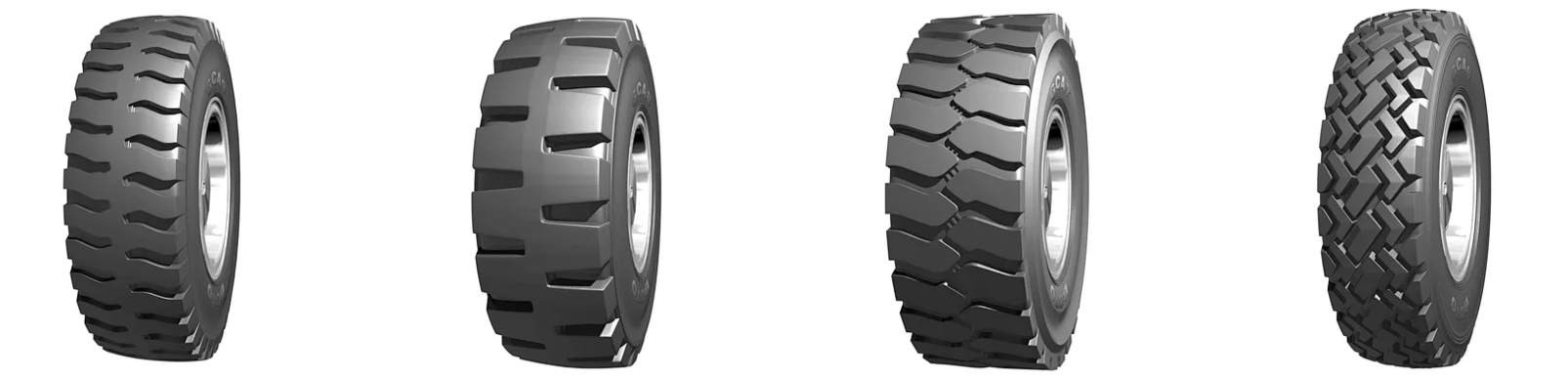
Common tire types mainly include L-3, L-4, and L-5, each with distinct tread designs, durability, and load-bearing characteristics.
4.1 L-3 Tires
Characteristics: L-3 tires have relatively deep tread patterns, suitable for operation on fairly level ground, providing adequate traction and good wear life. Suitable for lighter load environments.
Application Scenarios: Small to medium-sized open-pit mining, mine stockyards.
Common Specifications: 20.5-25 L-3, 23.5-25 L-3, 17.5-25 L-3. The 17.5-25 L-3 tires are particularly effective for smaller loaders in less demanding conditions.
4.2 L-4 Tires
Characteristics: L-4 tires have thicker sidewalls than L-3 types, enhancing wear and cut resistance, suitable for heavier load environments.
Application Scenarios: Medium to large-scale open-pit mining operations, especially high-load tasks like ore loading and transport.
Common Specifications: 23.5-25 L-4, 26.5-25 L-4, 29.5-25 L-4. The 26.5-25 L-4 tires provide exceptional durability for heavy-duty applications in challenging mining environments.
4.3 L-5 Tires
Characteristics: L-5 tires feature the thickest sidewalls and deepest tread patterns, designed specifically for extreme operating conditions. They offer very high wear and cut resistance, capable of withstanding heavy loads and high impacts.
Application Scenarios: Ultra-large open-pit mining operations, especially suitable for deep excavation, large-scale ore loading, etc.
Common Specifications: 23.5-25 L-5, 26.5-25 L-5, 33.25-29 L-5. Both 23.5-25 and 26.5-25 L-5 tires deliver maximum performance under the most extreme mining conditions.
BIAS OTR

RADIAL OTR
5 Essential Tips for Choosing the Right Earthmover Tires for Your Equipment
4 Essential Tips for Choosing the Right Front End Loader Tires