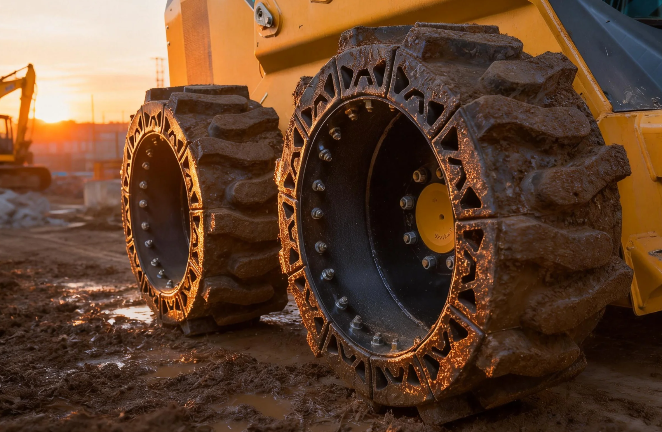
Urethane vs. Rubber Solid Tyres: A Technical Deep Dive
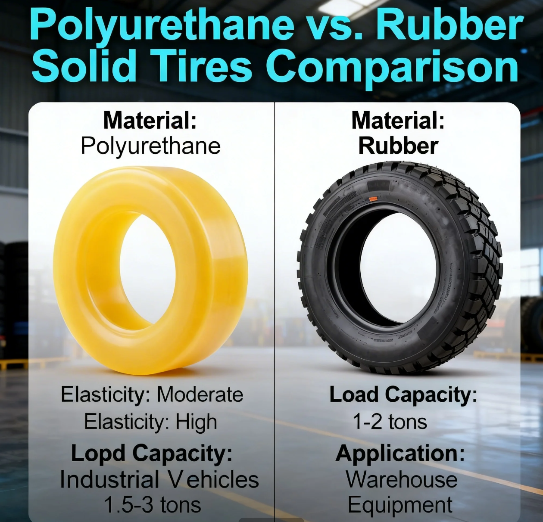
When flat-proof reliability is non-negotiable for your industrial equipment, solid tyres are the definitive solution. However, the choice between the two primary materials—polyurethane and rubber—extends far beyond a simple preference. It represents a fundamental decision between two distinct material sciences, each with unique chemical properties that define their ultimate performance boundaries. For professionals in ports, heavy industry, and demanding material handling, selecting the wrong material can lead to premature failure, excessive downtime, and higher total cost of ownership. This article provides a detailed technical analysis of urethane and rubber solid tyres, moving beyond marketing claims to examine the core chemistry and physics that dictate where each excels and where it reaches its limit.
1. The Core Chemistry: Two Paths to Durability
The fundamental performance differences between urethane and rubber solid tyres originate at the molecular level.
Rubber (Elastomer) Solid Tyres: The Traditional Workhorse
Traditional solid tyres are made from vulcanized rubber, a process that cross-links polymer chains (like natural or synthetic rubber) with sulphur to create a resilient, elastic network. This structure provides excellent vibration absorption and a degree of compliance, contributing to good operator comfort and ground protection. The formulation can be adjusted to achieve various hardness levels, typically ranging from a soft 50 Shore A for high cushioning to a harder 80+ Shore A for increased load capacity. However, rubber’s organic polymer chains are more susceptible to abrasion, tearing, and degradation from oils, ozone, and certain chemicals over time.
Polyurethane (PU) Solid Tyres: The Engineered Polymer
Polyurethane is a synthetic polymer created by reacting diisocyanates (like MDI or TDI) with polyols. This chemistry allows for precise engineering of the final material's properties. By altering the types and ratios of these components, manufacturers can produce urethanes with a very high density of cross-links and strong intermolecular forces (hydrogen bonding). This results in a material that is inherently more resistant to abrasion, cutting, and tearing than most rubbers. Urethane tyres typically have a higher hardness, often in the 85-95 Shore A range, which translates to superior load-bearing capacity and resistance to deformation under heavy weights.
2. Performance Boundaries: A Comparative Analysis
The distinct chemical foundations lead to clear, practical differences in performance. The following table summarizes the key operational boundaries of each material:
| Performance Characteristic | Polyurethane (PU) Solid Tyre | Rubber Solid Tyre | Key Implication for Selection |
|---|---|---|---|
| Abrasion & Wear Resistance | Excellent. Often cited as 3-4 times the tread life of standard rubber in high-abrasion settings. | Good, but wears faster under constant abrasive stress. | PU is superior for high-mileage applications on asphalt, concrete, or in scrapyards. |
| Cut & Tear Resistance | Exceptional. The dense polymer structure resists penetration and tearing from sharp debris. | Moderate. More prone to cuts and chunking, especially in demolition or recycling. | PU is mandatory for extreme environments with metal shards, glass, or rocks. |
| Load Capacity & Deformation | Very High. Higher hardness and tensile strength minimize rolling resistance and deformation under extreme loads. | High, but exhibits greater deformation (bulging) under load, increasing rolling effort. | PU provides better stability and energy efficiency for consistently heavy loads. |
| Vibration Damping & Comfort | Fair to Good. Newer formulations and hybrid designs with air vents or elastic layers improve comfort. | Excellent. The inherent elasticity of rubber provides superior shock absorption and operator comfort-. | Rubber is preferred for long shifts or on uneven terrain where operator fatigue is a concern. |
| Environmental & Chemical Resistance | Excellent resistance to oils, greases, and many chemicals. Can be formulated for hydrolysis resistance. | Variable. Standard rubber swells in oil; special compounds (e.g., nitrile) are needed for chemical resistance-. | PU is ideal for workshops, factories, and ports with fluid spills. Always check compatibility charts. |
| Operational Temperature Range | Good. Performance stable across a wide range, but extreme cold can reduce elasticity. | Good. Specific compounds like super-elastic solid rubber perform from -22°F to over 200°F. | Both perform well in most conditions; consult spec sheets for extreme environments. |
| Cleanliness & Marking | Excellent. Can be produced in light, non-marking colors (grey, green) for clean-room or food-grade applications-. | Poor (Standard Black). Carbon black filler leaves marks. Non-marking grey versions are available but may wear faster. | PU is the default choice for industries with strict floor cleanliness requirements (e.g., food, pharma, electronics). |
3. Application-Specific Recommendations: Matching Material to Mission
Choosing between urethane and rubber is not about finding a universally "better" material, but about matching its performance boundary to your specific operational "battlefield."
When to Specify Polyurethane Solid Tyres:
-
High-Abrasion, High-Cycle Environments: Container ports, bulk distribution centers, and manufacturing plants where equipment runs constantly on hard surfaces. The 3-4x wear life directly lowers long-term replacement costs and downtime.
-
Extreme Hazard Zones: Scrap metal recycling, demolition sites, glass handling, and mining. The exceptional cut and tear resistance is a safety and reliability imperative.
-
Clean and Controlled Industries: Food & beverage processing, pharmaceutical manufacturing, and clean-room logistics. The non-marking, easy-to-clean properties are essential.
-
Heavy and Precise Load Handling: For applications where minimal tyre deformation under multi-ton loads is critical for stability and precision, such as with large reach stackers or forklifts.
When to Specify Rubber Solid Tyres:
-
Prioritizing Operator Comfort: In applications like airport baggage handling, warehouse order picking, or on rough yard terrain where operator comfort over long shifts is paramount to productivity and safety.
-
Outdoor and Uneven Terrain: The superior elasticity and damping of advanced compounds (like super-elastic solid rubber) better handle bumps, cracks, and minor irregularities on docks and construction sites.
-
Cost-Sensitive, Lower-Abrasion Applications: For lighter-duty, intermittent use where the lower initial purchase cost of rubber is a key factor, and the extreme durability of urethane is not fully utilized.
The Innovation of Hybrid and Filled Designs:
Technology is blurring these boundaries. Urethane-Rubber Hybrids combine a urethane tread for wear resistance with a rubber core or cushion layer for comfort, offering a compelling middle ground-4. Conversely, Polyurethane Filling of standard pneumatic tyre casings is a process that injects liquid urethane that cures into a solid, flat-proof core, offering a cost-effective retrofit option with good performance.
Conclusion
The decision between urethane and rubber solid tyres is a strategic engineering choice. Urethane, with its superior abrasion, cut resistance, and load stability, is the performance champion for the most punishing, high-throughput industrial applications. Rubber, with its unbeaten shock absorption and comfort, remains the ergonomic choice for environments where operator well-being and variable terrain are key concerns. By understanding the chemical properties that define these performance boundaries, fleet managers and equipment specifiers can move beyond guesswork and make a precise, cost-effective selection that maximizes uptime, safety, and productivity.
Skid Steer Solid Tires Slipping? 3 Key Fixes for Immediate Grip